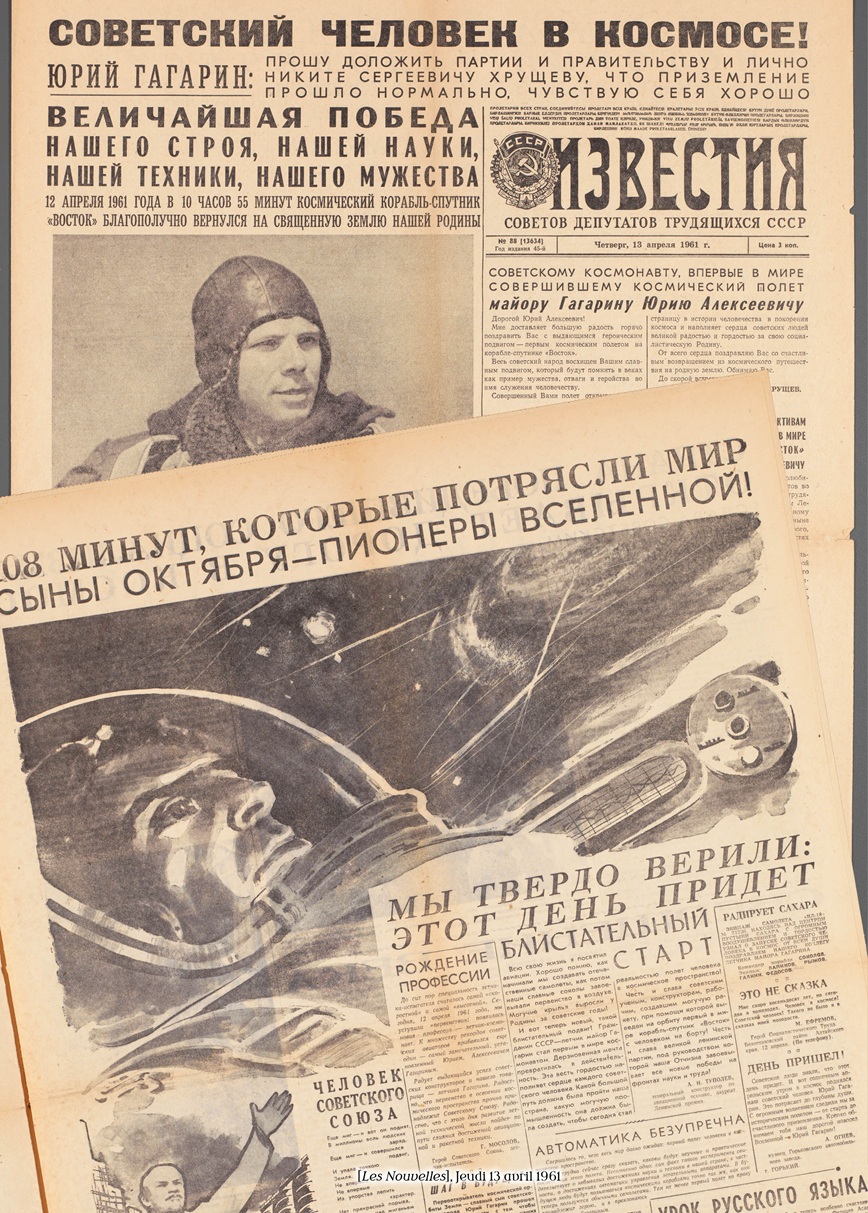
[Les Nouvelles], Jeudi 13 avril 1961
FR :
L’Espace est l’accomplissement de l’Envol. Une nouvelle génération de pionniers prit place un siècle après ceux de l’aviation pour tenter de rendre réelles les aventures jadis limitées aux romans de science-fiction.
Les percées technologiques majeures furent accomplies par les savants nazis travaillant à leurs missiles balistiques. Avant même la fin de la Seconde Guerre mondiale, les nouveaux maîtres du monde – l’URSS de Staline et les Etats-Unis de Truman – se partagent les scientifiques du IIIe Reich vaincu et leur offrent les meilleures conditions de travail possibles. La Guerre froide sera l’occasion historique pour mettre en œuvre les défis techniques et les expérimentations les plus folles.
Spoutnik 1, lancé le 4 octobre 1957, est le premier satellite artificiel placé en orbite terrestre : c’est l’inauguration de la course à l’espace. La même année Spoutnik 2 embarque la chienne Laïka qui ne survit pas longtemps. En 1960, Spoutnik 5 réussit à ramener vivant sur Terre l’ensemble de son équipage composé de plantes, souris, rats et chiens.
Mais c’est bien le 12 avril 1961 que l’URSS envoie et récupère sain et sauf le premier être humain à se rendre dans l’espace : Youri Gagarine. Le cosmonaute fit une révolution planétaire en 1 heure et 48 minutes. Ses chances de réussite étaient estimées à 50 %. Une autre tournée mondiale, cette fois-ci à des fins de propagande (terme remplacé de nos jours par « communication »), débute alors pour lui.
Nous voyons sur cette planche l’édition du jeudi 13 avril 1961, au lendemain de l’événement, du journal « Известия », ou « Izvestia » (« Les Nouvelles »), un des grands journaux russes, fondé en 1905 par le premier soviet de Saint-Pétersbourg puis publié en 1917 durant la Révolution russe. Le journal, relais du Kremlin depuis la fin de la Seconde Guerre mondiale, est toujours actif aujourd’hui.
EN :
Space is the final stage of flight. A new generation of pioneers was ushered in a century after those in aviation to attempt to make a reality the adventures that had previously been consigned to science fiction novels.
Major technological breakthroughs were achieved by Nazi scholars working on their ballistic missiles. Even before the end of the Second World War, the now leaders of the world- the USSR and Truman’s United States- divided up between them the scientists of the defeated 3rd Reich, offering them the best possible working conditions. The Cold War was a historic opportunity to set up the most unimaginable experiments and technical challenges.
Sputnik I, launched on 4th October 1957, was the first artificial satellite sent into orbit of Earth- this was the start of the space race. The same year, Sputnik II boarded the dog Laika; she was not long for the world. In 1960, Sputnik V successfully landed back down on Earth with its whole crew of plants, rice, rats, and dogs still alive.
But it was on 12th April 1961 that the USSR sent the first human being into space- Yuri Gagarin- and brought him back safe and well. The cosmonaut orbited the Earth in 1:48m. His chances of success were estimated at 50%. Another world tour, this time for propaganda reasons (a term replaced nowadays by “communication”), then began.
On this board we can see the Thursday 13th April 1961 issue of “Известия” or “Izvestia” newspaper (“The News”), one of the great Russian newspapers, founded in 1905 by the first St Petersburg Soviet, then published in 1917 during the Russian Revolution. The mouthpiece of the Kremlin from the end of the Second World War, the newspaper is still active today.