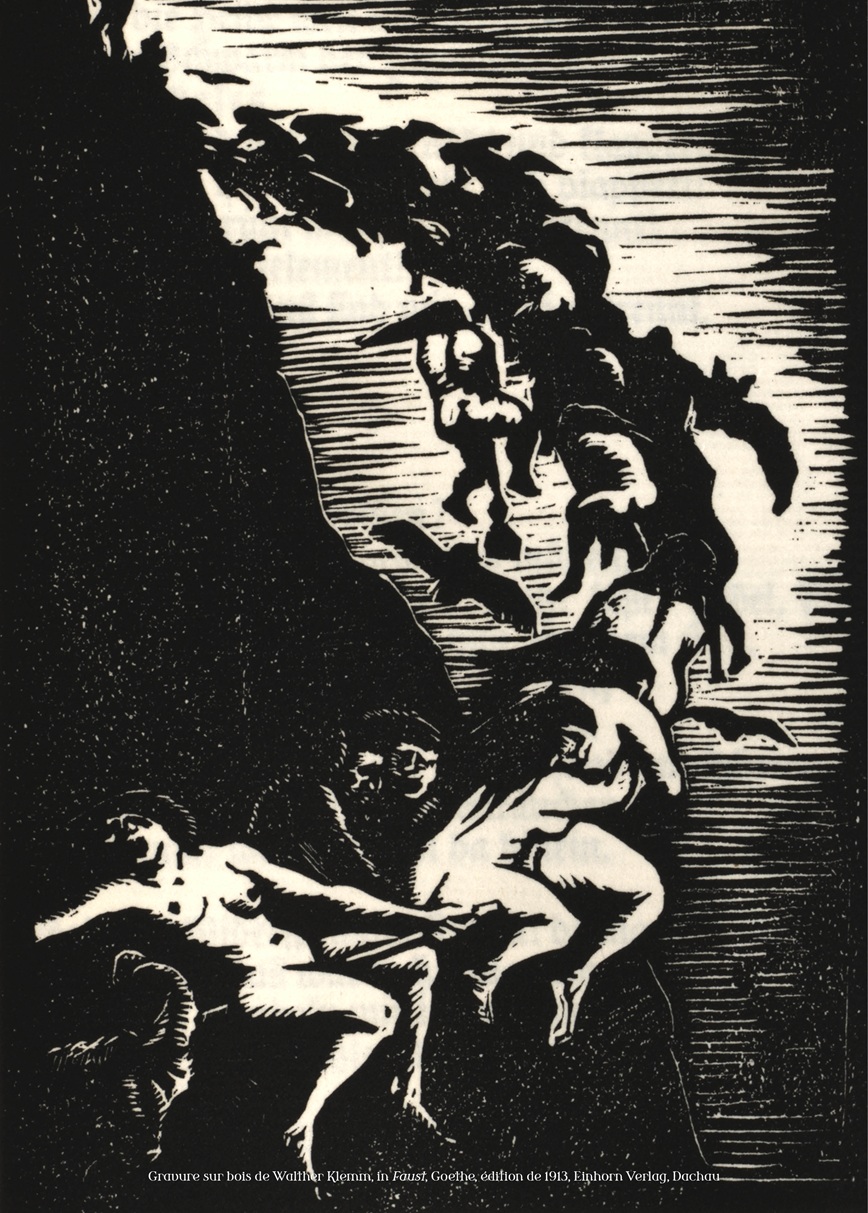
Gravure sur bois de Walther Klemm, in Faust, Goethe, édition de 1913, Einhorn Verlag, Dachau
FR :
Lorsque l’on pense à des êtres humains volants, la figure de la sorcière accompagnée de ses chaudrons, de sa cabane forestière et de son balai ressurgit rapidement dans l’imaginaire collectif. Omniprésente dans les contes depuis des siècles sous des formes très diverses, la sorcière semble se renouveler sans cesse : le succès de la saga Harry Potter tout comme celui de sa récupération féministe actuelle en témoignent.
Faust est l’œuvre majeure de Goethe, le père des Lettres allemandes. Dans la première partie (publiée en 1808) un long chapitre raconte comment l’érudit Johann Faust, accompagné de l’émissaire du Diable dénommé Méphistophélès, se retrouve spectateur du Sabbat des sorcières sur la montagne du Harz, la nuit de Walpurgis, c’est-à-dire le 1er mai.
Alors, comme Méphistophélès le constate (dans une traduction du fascinant poète Gérard de Nerval) « la montagne retentit dans toute sa longueur d’un furieux chant magique », et les deux chœurs de sorcières proclament :
« Le balai, le bouc et la fourche
Sont là : que chacun les enfourche !
Aujourd’hui qui n’est pas monté
Est perdu pour l’éternité.
[…]
Au sommet nous touchons bientôt ;
Que chacun donc se jette à terre,
Et que, de là, l’armée entière
Partout se répande aussitôt. »
Les éditions de Faust n’ont cessé de se multiplier dans toutes les langues et dans tous les formats depuis la parution de la première partie du drame. Cette édition allemande parue plus d’un siècle après l’originale en est un bon exemple, avec ses magnifiques gravures sur bois pleine page, tout en contrastes, en pleine naissance du courant expressionniste. Son auteur Walter Klemm, qui étudia à Vienne avant de s’installer à Prague, fut membre de la Sécession viennoise puis de la Sécession berlinoise.
EN :
When we think of flying figures, witches, along with their cauldron, house in the woods, and broomstick quickly appear in the popular imagination. Omnipresent in tales in various forms for centuries, the witch seems to constantly reinvent herself- the success of the Harry Potter series, as well as its current feminist revival demonstrate this.
Faust is the greatest work of Goethe, the grandfather of German literature. In its first part (published in 1808) a long chapter recounts how scholar Johann Faust, accompanied by the emissary of the Devil, named Mephistopheles, becomes a spectator to a Witches’ Sabbath in the Harz mountains on Walpurgis Night (night of 30th April-1st May).
As Mephistopheles notes (in this translation by Charles Timothy Brooks) “Through the mountain, all along, / Swells a torrent of magic song.”, and the two choruses of witches proclaimed:
“Can ride the besom, the stick can ride,
Can stride the pitchfork, the goat can stride;
Who neither will ride to-night, nor can,
Must be forever a ruined man.
[…]
And when the highest peak we round,
Then lightly graze along the ground,
And cover the heath, where eye can see,
With the flower of witch-errantry.”
Faust has continued to be published in a plethora of languages and formats since the first part of the drama was first published. This German edition, which was published more than a century after the original is a good example, with its magnificent full-page wood engravings, full of contrast, created at the inception of the expressionist movement. The artist Walter Klemm, who studied in Vienna before moving to Prague, was a member of the Vienna Secession and then the Berlin Secession.