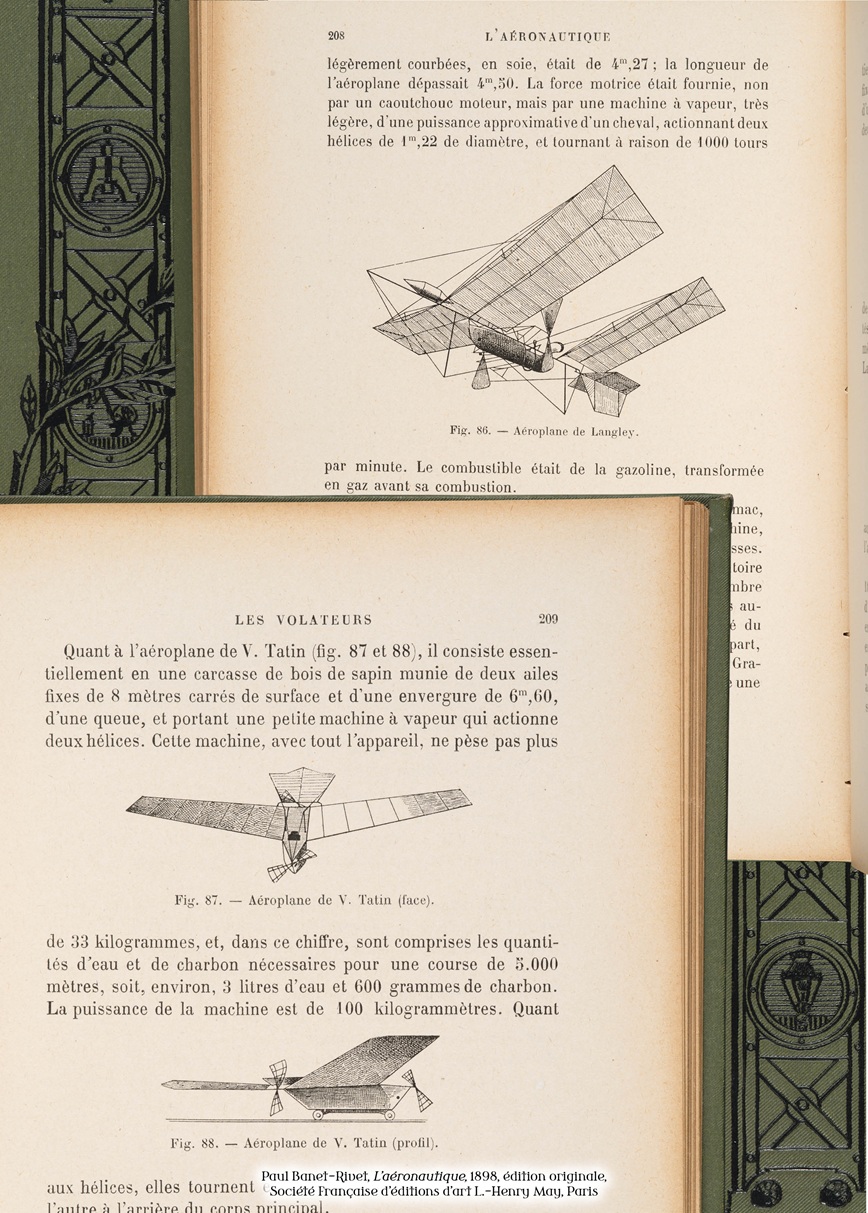
Paul Banet-Rivet, L’aéronautique, 1898, Société française d’éditions d’art L.-Henry May, Paris, édition originale
FR :
« De tout temps et en tout lieu, l’homme s’est demandé s’il ne serait pas possible d’imiter l’oiseau et de quitter la terre en s’élevant dans les airs ». C’est avec ces quelques mots que Paul Banet-Rivet, professeur agrégé de physique, commence son ouvrage technique et historique devenu référence.
C’est avec ces livres de pointe, proches des manuels, que l’on peut mesurer l’écart abyssal creusé en peu de temps avec les siècles précédents. En effet, sorti des mythes et des rêveries, le vol est passé dans le registre de l’exploit et commence sa future banalisation. Les extraits descriptifs que nous pouvons lire ici représentent ce basculement : le vol aérien se déploie désormais en longs développements scientifiques au ton neutre et objectif.
Né en 1848, Président de la Société Française de navigation aérienne et lui-même pilote, Paul Banet-Rivet nous détaille dans cet ouvrage l’étendue des connaissances sur l’étude, la construction et la manœuvre des appareils volants. Enrichi d’équations et de schémas, il aborde les technologies, inventions et figures clés relatives aux aérostats, dirigeables ou autres hélicoptères.
EN :
“Across all of time and all places, man has wondered whether it would not be possible to imitate the bird and leave the ground by rising up into the air”. It is with these brief words that Paul Banet-Rivet, Associate Professor of physics, opens his technical and historical work, which has become iconic.
These cutting-edge books, almost manuals, allow us to measure the yawning gulf that so quickly opened up between then and previous centuries. Indeed, leaving myth and reverie behind, flight entered the list of great human endeavours and began on its path to banality. The descriptive extracts we can read here show this swing of the pendulum- flight was now the subject of long, scientific texts, in an objective, neutral tone.
Born in 1848, president of the French Society of Air Navigation, and a pilot himself, Paul Banet-Rivet details in this text the breadth of knowledge on the study, construction, and operation of flying machines. Supplemented with equations and diagrams, he looks at the technologies, inventions, and key figures relating to aerostats, airships, and other helicopters.