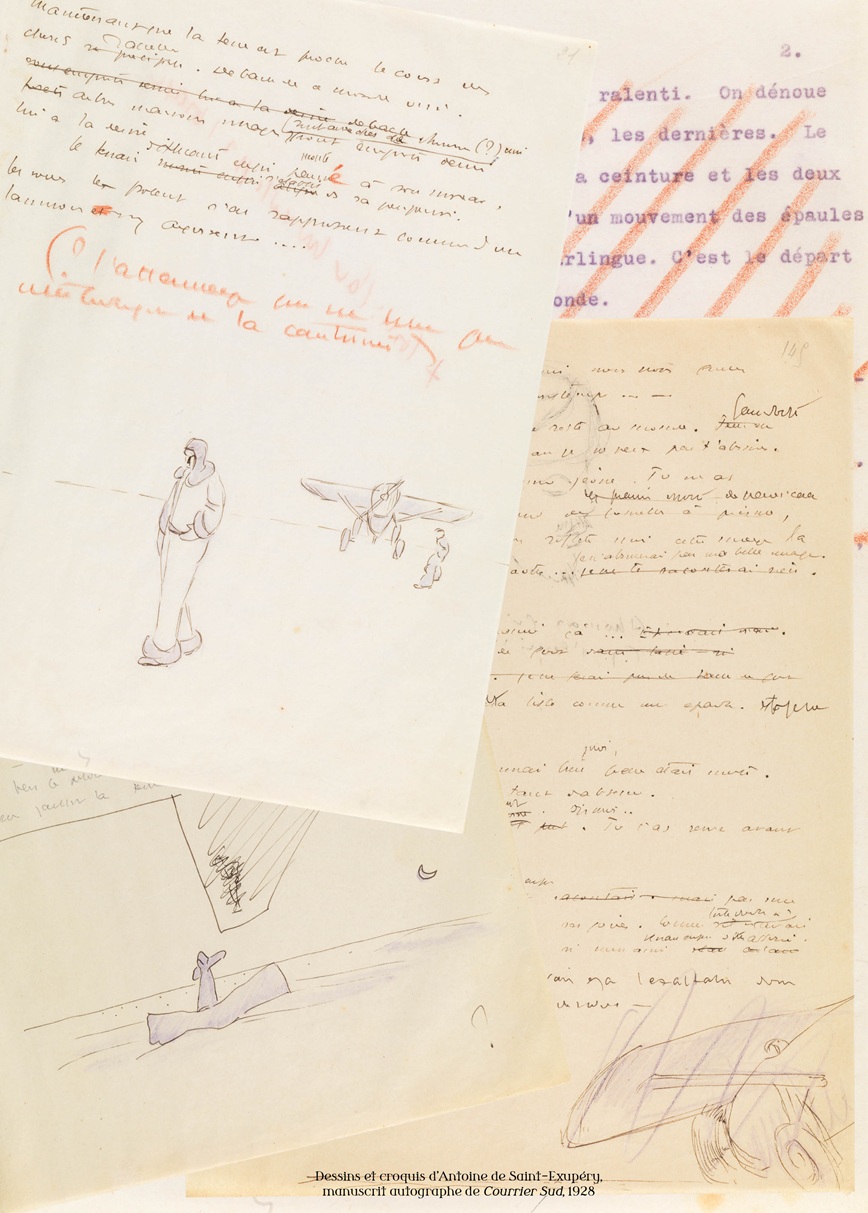
Dessins et croquis d’Antoine de Saint-Exupéry, manuscrit autographe de Courrier Sud, 1928
FR :
« Un ciel pur comme de l’eau baignait les étoiles et les révélait. Puis c’était la nuit. Le Sahara se dépliait dune par dune sous la lune. Sur nos fronts cette lumière de lampe qui ne livre pas les objets mais les compose, nourrit de matière tendre chaque chose. Sous nos pas assourdis, c’était le luxe d’un sable épais. Et nous marchions nu-tête, libérés du poids du soleil. »
Il arrive que de grands écrivains soient également pilotes d’avion. La Fondation Martin Bodmer a l’honneur de conserver le manuscrit/tapuscrit de 1928 de Courrier Sud, roman qui sera publié l’année suivante chez Gallimard. Il raconte l’histoire d’amour contrariée d’un pilote de la poste aérienne, reliant Toulouse à Dakar.
Le récit est très largement composé d’éléments biographiques de l’auteur. Le manuscrit d’environ 200 pages est signé « S. Exupéry. Cap Juby 1928 ». Antoine de Saint-Exupéry fut nommé en 1927 chef d’aéroplace à Cap Juby, au sud du Maroc, alors sous administration espagnole.
À l’ombre d’une forteresse de fortune, coincée entre le désert, l’océan et la menace des fusils aux alentours, Saint-Ex’ manifeste une passion pour le Sahara en même temps qu’il rédige son roman, et imagine le futur Petit Prince. On y retrouvera son célèbre renard (« on ne voit bien qu’avec le cœur »), inspiré sans doute du fennec qu’il apprivoisa durant son séjour au Cap Juby.
La destinée semble parfois écrite ou dessinée à l’avance, comme un avion écrasé sur un croquis de manuscrit. En juillet 1944 l’écrivain commandant est porté disparu lors d’une mission de reconnaissance pour les troupes Alliées. Il n’avait cessé d’insister pour qu’on le laissât participer à l’effort de guerre malgré son âge et ne semblait pas nourrir d’illusions quant à l’issue fatale qui l’attendait. En 1998 un pêcheur marseillais remonte la gourmette de Saint-Exupéry au large de la Cité phocéenne ; en 2000, des éléments de son F-5 Lightning sont retrouvés, plus d’un demi-siècle après le début des recherches.
EN :
“A sky as pure as water bathed the stars and brought them out. And then night fell. Dune by dune the Sahara unfolded itself beneath the moon. Its light, falling on our foreheads with the pallor of a lamp which blends the softened forms, enveloped every object in its velvet sheen. Under our soundless footsteps the sand had the richness of a carpet. And bare-headed we walked, freed of the cruel weight of the sun.”
It can happen that great writers are also aeroplane pilots. The Martin Bodmer Foundation is honoured to conserve the handwritten and typed text of Southern Mail from 1928, a novel that was published the following year by Gallimard. It tells the story of thwarted love of an air post pilot, flying from Toulouse to Dakar.
The tale draws significant inspiration from real aspects of the author’s life. The roughly 200-page manuscript is signed “S.Exupéry. Cape Juby 1928”. In 1928, Antoine de Saint-Exupéry was appointed Chief of the airfield in Cape Juby, southern Morocco, at the time under Spanish administration.
In the shade of a makeshift fortress, stuck between the desert, the ocean, and with the threat of gunshot all around, Saint-Exupéry shows a passion for the Sahara as he writes his novel and imagines the future Little Prince. In it we would discover his famous fox (“It is only with the heart that one can see rightly”), undoubtedly inspired by the fennec fox he tamed during his stay in Cape Juby.
Destiny sometimes seems to have been written or drawn ahead of time, like an aeroplane crash in a manuscript sketch. In July 1944, the writer and squadron leader was reported missing during a reconnaissance mission for the allied troops. He had insisted on being allowed to take part in the war effort despite his age, and did not seem to be under any illusion as to the deadly outcome that awaited him. In 1998 a fisherman from Marseilles found Saint-Exupéry’s bracelet off the city’s coast; in 2000, parts of his F-5 Lightning were found, more than half a century after the search had first begun.