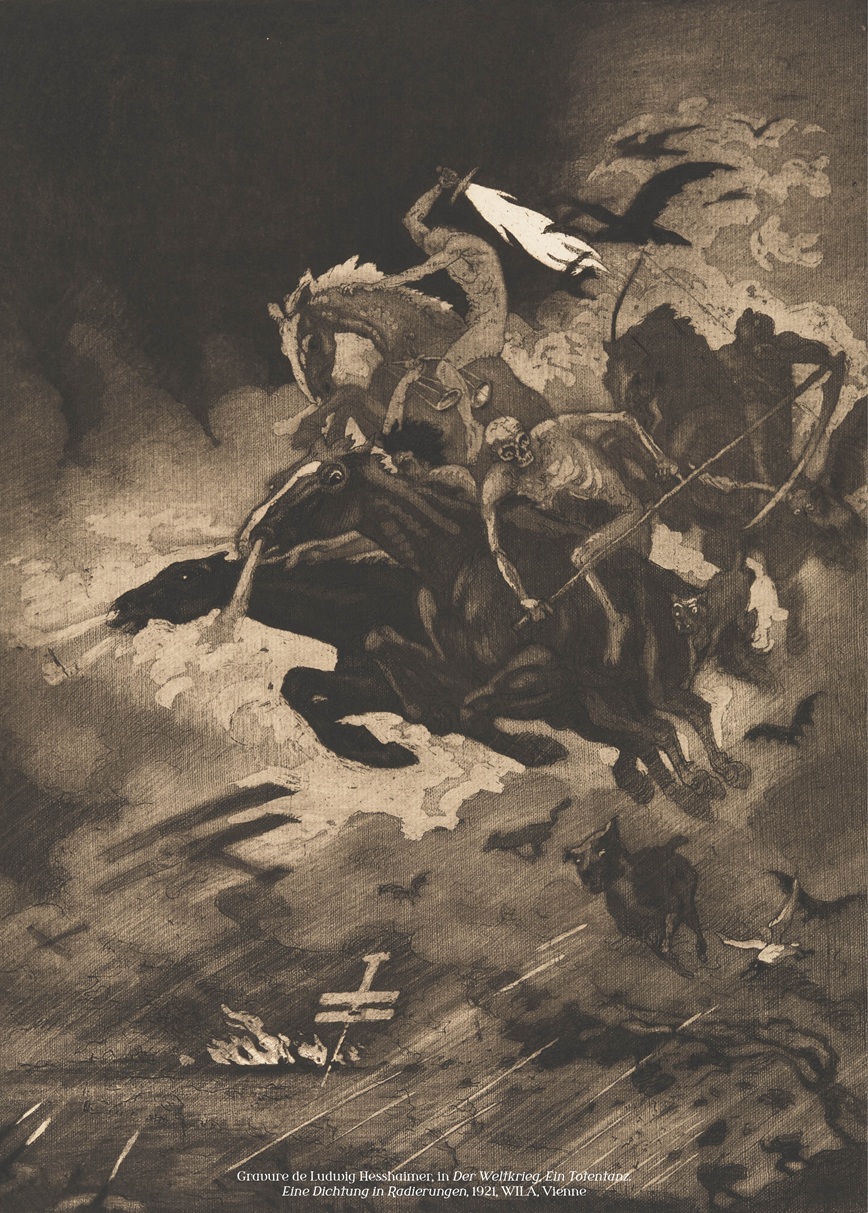
Gravure de Ludwig Hesshaimer, in Der Weltkrieg, Ein Totentanz. Eine Dichtung in Radierungen, 1921, WILA, Vienne
FR :
L’augmentation des moyens techniques a toujours coïncidé, durant toute l’histoire d’Homo sapiens, avec l’accroissement de notre pouvoir de destruction. L’aviation n’échappera pas à cette règle.
La Première Guerre mondiale fut le premier conflit d’ampleur à mobiliser les « aérodynes ». Ce fut également une occasion pour de nombreux artistes plasticiens germaniques de se réapproprier le genre de la danse macabre (Totentanz en allemand), qui, depuis le début du Moyen Âge, illustre l’omniprésence de la mort dans la vie humaine, tels que Albin Egger-Lienz, Otto Dix ou encore Lovis Corinth.
La vie de Ludwig Hesshaimer, officier ayant pris congé pour se former en arts graphiques à Vienne, mêle intrinsèquement guerre et création. Réintégré en tant que capitaine de l’armée impériale, il devient professeur d’une école militaire à Sarajevo. A l’occasion de la visite de l’archiduc François-Ferdinand (le 28 juin 1914), Hesshaimer devait lui remettre un portfolio de paysages. Ce projet fut empêché de la façon la plus tragique.
Hesshaimer est alors affecté au quartier général de la presse de guerre et participe en tant qu’officier actif aux combats sur plusieurs fronts. Il publie parallèlement « Heil und Sieg », son premier portfolio d’illustrations en 1915. « Der Weltkrieg » naît plusieurs années après l’armistice, aidant son auteur à surmonter les traumatismes du conflit.
Il s’agit d’un ensemble de 15 illustrations, « un poème en gravure », à la puissance visuelle époustouflante. La Mort y apparaît dès la première planche et menace d’anéantir l’Humanité. Les cavaliers de l’Apocalypse (ici sur la sixième gravure) déferlent sur le monde. Les machines se transforment en monstres d’acier. Même le Christ, sacrifié pour l’humanité, ne peut mettre fin à ce cauchemar.
Cependant dans la treizième gravure nous voyons le démon Moloch, assis sur une pyramide de crânes, tenir dans ses bras la mort endormie, finalement lassée de tuer. Les deux dernières planches sont empreintes d’optimisme : la foi en l’avenir, en la lumière et en l’amour triomphe des forces des ténèbres. « La vie appelle, la mort est morte, la création est le commandement suprême de la création », proclame une jeune femme avec un enfant.
EN :
Throughout mankind’s history, technological progress has always gone hand in hand with an increase in our destructive power. Aviation is no exception.
The First World War was the first major conflict to use “aerodynes”. It was also the opportunity for many German-speaking artists to reappropriate the Totentanz (dance of death) genre, which had illustrated the omnipresence of death in life since the start of the Middle Ages, with artists such as Albin Egger-Lienz, Otto Dix and Lovis Corinth.
The life of Ludwig Hesshaimer, an officer who had taken leave to train in graphic arts in Vienna, inextricably links war and creativity. He rejoined as a captain of the Imperial Army, and become a professor at a military school in Sarajevo. It was planned that Hesshaimer should present Archduke Franz-Ferdinand with a portfolio of landscapes during a visit on 28th June 1914. Tragedy prevented this from taking place.
Hesshaimer was then assigned to the War Press Headquarters and took part in active combat as an officer on various fronts. In parallel, he published “Heil und Sieg”, his first portfolio of illustrations in 1915. “Der Weltkrieg” was born several years after the armistice, helping the artist overcome the trauma of the conflict.
It was a collection of 15 illustrations, “poetry through engraving”, of breathtaking visual power. Death is present from the first plate, and threatens to wipe out humanity. The horsemen of the apocalypse (on the sixth engraving) are unleashed on the world. Machines are transformed into steel monsters. Even Christ, sacrificed to save mankind, cannot put an end to the nightmare.
However, in the thirteenth engraving we see the demon Moloch, seated on a pyramid of skulls, holding death asleep in his arms, finally weary of killing. The last two plates are infused with optimism- faith in the future, in light, in love triumphing over the forces of darkness. “Life cries out, Death is Dead, “Procreation” is the cosmos’s highest offering!” proclaims the young woman with a child.