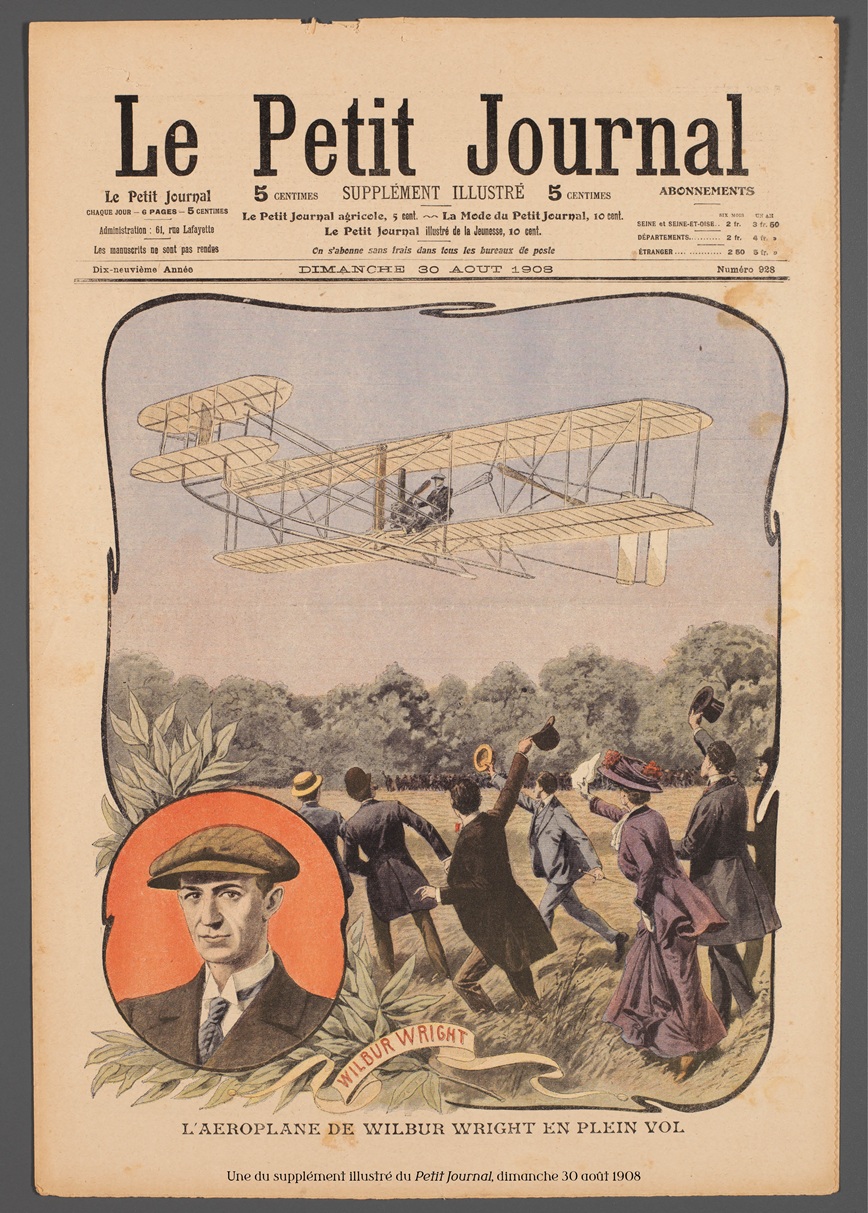
Une du supplément illustré du Petit Journal, dimanche 30 août 1908
FR :
On nomme « incunables » les livres imprimés durant les cinquante premières années de l’imprimerie moderne, mise au point par Gutenberg vers 1450. Durant cette courte période les ingénieurs, typographes, imprimeurs et chimistes de différents pays rivalisèrent de créativité pour faire évoluer cette nouvelle manière de fabriquer un livre. Les premières décennies de l’aviation n’ont pas de nom mais l’on retrouve le même esprit : celui des pionniers, des casse-cous et des inventeurs.
L’ingénieur Clément Ader est le premier à faire décoller un engin motorisé, avec son étrange « Éole » ; Gabriel Voisin décolle en hydravion de la Seine en 1905 ; Louis Blériot réalise la première traversée de la Manche en 1909 (Calais-Douvres en 30 minutes) ; la liste est longue et s’étend jusqu’à Charles Lindbergh, traversant pour la première fois l’Atlantique sans escale en 1927, pour atterrir à l’aéroport du Bourget sous les acclamations, après plus de 33 heures de vol.
Les frères Wilbur et Orville Wright sont deux ingénieurs étasuniens (Dayton, Ohio). Ils effectuent depuis plusieurs années des vols sur planeurs quand ils parviennent fin 1903 à réaliser le premier vol motorisé contrôlé de l’histoire. Cette prouesse est accomplie par leur approche méthodique, s’appuyant sur les essais en soufflerie et leur compréhension avant-gardiste des mécaniques de vol.
Les Wright améliorent par la suite leurs avions, mais dès 1905, personne n’assiste plus à aucun essai, et le travail technique est arrêté : les frères préfèrent en effet attendre l’obtention de leurs brevets, considérant qu’ils ont plusieurs années d’avance sur leurs concurrents. Et ce n’est qu’en 1908, après un contrat signé auprès de la Compagnie générale de navigation aérienne, que Wilbur transporte un Model A jusqu’au Mans pour faire une série de démonstrations spectaculaires, mise à l’honneur par cette édition du Petit Journal.
Le triomphe sera cependant de courte durée, puisqu’un an plus tard, les fabricants français comme le constructeur Curtiss aux États-Unis feront déjà mieux. Si les frères Wright eurent une longueur d’avance par leurs techniques de vol, la conception de leur aéroplane était devenue trop arriérée. L’année 1908 fut donc pour Orville et Wilbur l’année des records tout autant que leur chant du cygne.
EN :
We call books printed during the first fifty years of modern printing, developed by Gutenberg in around 1450, “incunables”. During this brief period, engineers, typographers, printers, and chemists from different countries rivalled each other in creativity to try to drive forward this new way of creating books. The first few decades of aviation do not have a specific name, but the spirit was the same- that of pioneers, daredevils, and inventors.
The engineer Clément Ader was the first to make a motorised vehicle take off, with his strange “Éole”; Gabriel Voisin took off from the Seine in a seaplane in 1905; Louis Blériot achieved the first crossing of the English Channel in 1909 (Calais-Dover in 30 minutes); the list is long and stretches all the way to Charles Lindbergh, who achieved the first non-stop crossing of the Atlantic in 1927, landing at Bourget airport to applause after more than 33 hours of flight.
The brothers Wilbur and Orville Wright were both American engineers (Dayton, Ohio). For years, they had been flying in gliders, when in 1903 they managed the first controlled, motorised flight in history. This prowess was achieved through a methodical approach, with trials in a wind tunnel and their avant-garde understanding of flight mechanics.
The Wright brothers subsequently improved their aeroplanes, but as of 1905 nobody attended any more trials, and their technical work was halted; the brothers decided to wait for their patents to be granted, believing that they were several years ahead of their competitors. Only in 1908, after having signed a contract with the General Air Navigation Company, did Wilbur transport a Model A to Le Mans for a series of spectacular demonstrations, featuring in this edition of the Petit Journal.
However, this triumph would be short-lived, as a year later French manufacturers and the manufacturer Curtiss in the United States would better them. Although the Wright brothers had a head start in terms of flying technique, the design of their aeroplane had become too outdated. For Orville and Wilbur, 1908 was therefore both a year of smashing records, as well as their swan song.