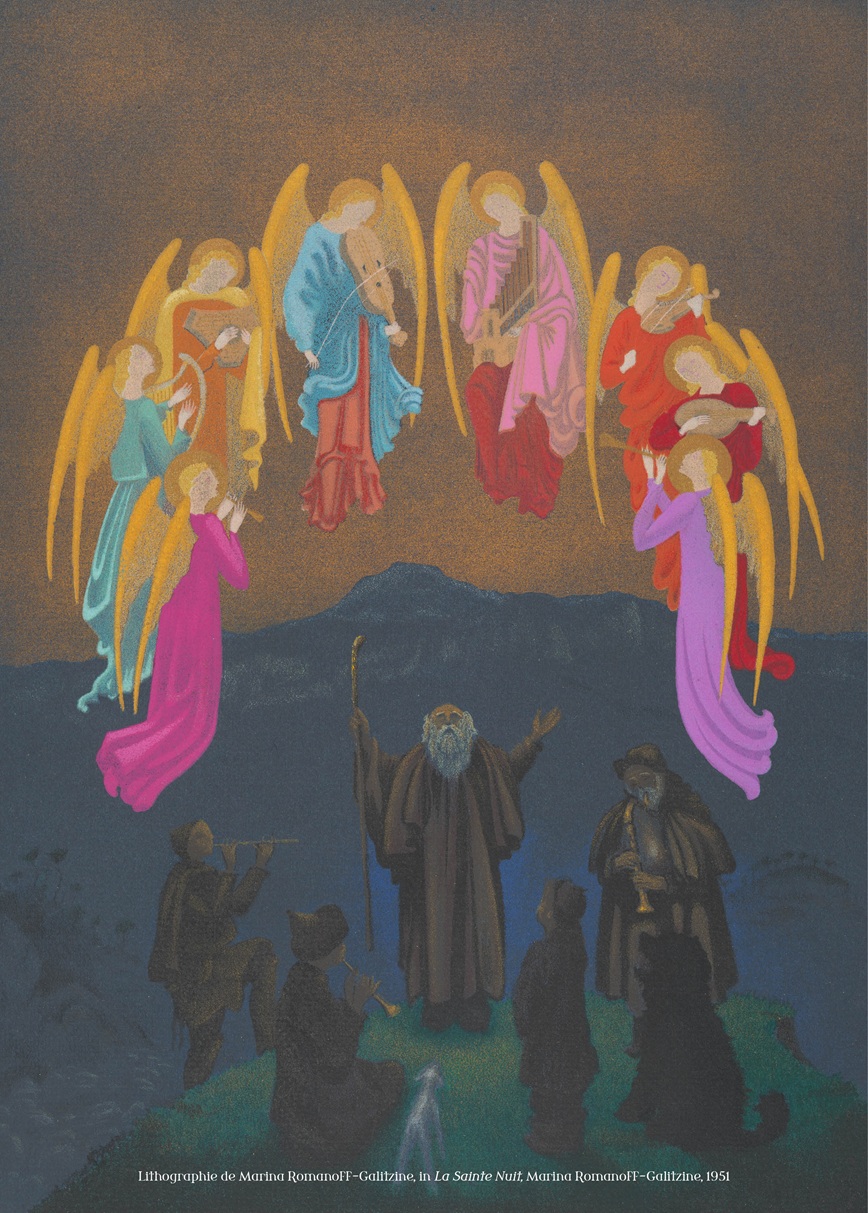
Lithographie de Marina Romanoff-Galitzine, in La Sainte Nuit, Marina Romanoff-Galitzine, 1951
FR :
Les anges (du latin angelus) sont incontournables lorsque l’on recense les différentes créatures humanoïdes volantes. Messagers de Dieu dans toutes les religions monothéistes, ils sont représentés – quand ils prennent une forme corporelle – par des êtres gracieux aux grandes ailes, parfois munis d’instruments, tels que la bombarde, la harpe ou la trompette.
La princesse Romanoff-Galitzine en offre un bel exemple avec ce grand dessin réalisé sur un papier Canson gris-bleuté puis lithographié, où huit anges flamboyants jouent à l’occasion de la nuit de Noël :
« Bergers quittez vos retraites, unissez-vous à nos concerts,
répétez sur vos musettes, ce chant qui vibre dans les airs ».
Cette planche est tirée du singulier livre « La Sainte Nuit. Noëls et Légendes en Poèmes », édité à 150 exemplaires en 1951, et principalement dessiné et calligraphié par l’auteure. Fille du grand-duc Pierre Nikolaïevitch de Russie et de son épouse née princesse Militza de Monténégro, Marina Petrovna Romanova de Russie (Nice, 1892-1981) est l’arrière-petite-fille du tsar Nicolas 1er.
Elle épouse en 1927 le prince Alexandre Galitzine et s’installe ensuite à Six-Fours-les-Plages (près de Toulon). Elle y créera plusieurs œuvres dont cette Sainte Nuit, recueil de légendes provençales mises en rimes et de transcriptions de chants populaires anciens.
Tout y est fait volontairement à la main pour aller à contre-courant d’un « siècle de machinisme outrancier », des lettrines enluminées par le prince jusqu’à l’impression, exécutée sur presse à bras.
EN :
We cannot talk about the various humanoid flying creatures without talking about angels (from the Latin angelus). They are the messengers of God in all of the monotheistic religions and are represented- when they take on a bodily form- as graceful beings with large wings, sometimes carrying instruments such as the horn, the harp, or the trumpet.
The Princess Romanov-Golitsyn offers up a lovely example, with this large drawing on blueish-grey Canson paper, subsequently lithographed, in which eight angels ablaze play music at Christmas time:
“Shepherds, why this jubilee? Why your joyous strains prolong?
What the gladsome tidings be Which inspire your heavn’ly song?”.
This plate is taken from the unique book “The Holy Night. Christmas and Legends in Poems”, published in a run of 150 copies in 1951, largely illustrated and calligraphed by the author. Daughter of Grand Duke Peter Nikolaevich of Russia and his wife née Princess Milica of Montenegro, Marina Petrovna Romanov of Russia (Nice, 1892-1981) was the great-granddaughter of Tsar Nicholas I.
In 1927 she married Prince Alexander Golitsyn and moved to Six-Fours-les-Plages (near Toulon). It was there that she created several works, including The Holy Night, a collection of Provençal legends set in rhyme, and transcriptions of popular traditional songs.
Everything was deliberately done by hand to swim against the tide of “a century of outrageous mechanisation”, from the dropped capitals illuminated by the prince to the printing on a handpress.