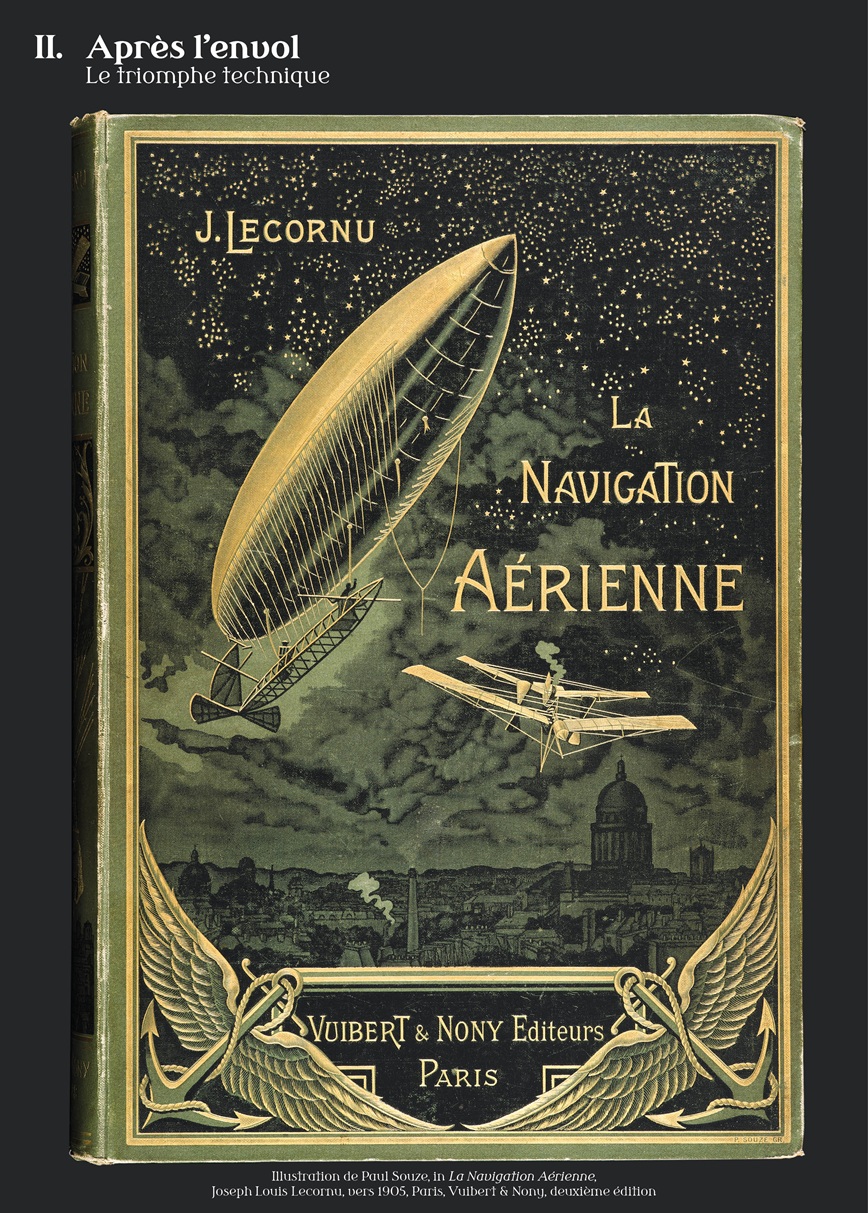
Illustration de Paul Souze, in La Navigation Aérienne, Joseph Louis Lecornu, vers 1905, Paris, Vuibert & Nony, deuxième édition
FR :
Seconde partie
Après l’envol : le triomphe technique
19 septembre 1783 : le roi Louis XVI assiste en plein Paris à l’envol du premier ballon à air chaud habité (par un coq, un mouton et un canard), celui des frères Montgolfier. Un mois plus tard et toujours au sein de la capitale, la montgolfière s’élève avec à son bord deux hommes, pour réussir le premier vol humain de l’Histoire.
C’est le tout début d’un développement extraordinaire, exponentiel et phénoménal qui se poursuit encore aujourd’hui, où des dizaines de milliers d’avions de ligne portant chacun des centaines de passagers se croisent en plein ciel chaque année. Il y eut un avant et un après.
Début 1900 : les pays européens sont encore bercés par l’idée du Progrès. Cette fierté générale se retrouve dans le monumentalisme façon Tour Eiffel, mais également dans la resplendissance de nombre d’ouvrages d’époque, même ceux dédiés à l’histoire de la technique.
Paul Souze, héritier d’une grande lignée de relieurs-graveurs, réalise cette grande plaque dorée pour le plat supérieur du livre, associant un dirigeable Santos Dumont et un aéroplane Langley dans la nuit étoilée de Paris et de son Panthéon.
J. L. Lecornu était ingénieur et membre de la Société Française de navigation aérienne. Cette « histoire documentaire et anecdotique » de la Navigation Aérienne porte un regard érudit sur l’histoire du vol, depuis ses précurseurs jusqu’aux grands dirigeables et au sport aérien. L’ouvrage, riche de plus de 350 illustrations, cartes et photographies, fut couronné par l’Académie française. Il connut un grand succès jusqu’à la Grande Guerre.
EN :
Part Two
After Take-off: Technical Triumph
On 19th September 1783 King Louis XVI attended the take-off of the first passenger-carrying hot-air ballon (carrying a rooster, a sheep, and a duck), owned by the Montgolfier brothers, in the middle of Paris. A month later, once again in Paris, the hot-air balloon took off with two men on board, successfully completing the first human flight in history.
This was the very beginning of a period of extraordinary, exponential, and phenomenal development, which continues today, in which tens of thousands of airliners, each carrying hundreds of passengers criss-cross the sky each year. It marks a turning point.
In the early 1900s, European countries were still gripped by the idea of progress. This general pride can be seen in the monumentalism of the Eiffel Tower, but also in the resplendence of many works of the time, even those dedicated to technical history.
Paul Souze, heir to a long line of binder-engravers, created this large golden plate for the front cover of the book, bringing together a Santos-Dumont airship and a Langley aeroplane under a starry Parisian night’s sky, complete with its Pantheon.
J.L. Lecornu was an engineer and member of the French Society of Air Navigation. This “documentary and anecdotal history” of air navigation looks at the history of flight through a scholarly lens, from its precursors, to the great airships and aviation sport. The book contains more than 350 illustrations, cards, and photographs and was awarded a prize by the Académie Française. It enjoyed great success up until the Great War.